The School Rebuilding Programme is accelerating but can the construction sector keep pace? Frameclad is already delivering education projects through industrialised construction, and as joint Managing Directors Nik Teagle and Martin Jamieson argue, this approach is no longer optional, its essential.
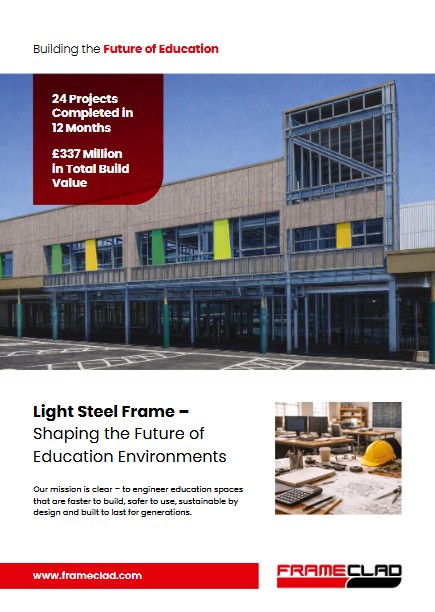
Despite the downturn in education builds, over the last 12 months alone our team has delivered light steel frame systems for 24 education schemes with a combined total build value of around £337million. And with what’s coming down the track, we’re ramping up for an even busier 2026.
A 15% rise in education project starts is forecast for this year, as the School Rebuilding Programme gathers pace. The programme itself is expanding, with 250 more schools being added, taking the total to 750 schools set for delivery by 2035. With the next round of nominations reopening soon, the pipeline is only getting stronger.
And it’s not just new schools. A £38billion capital investment in education is committed between 2025 and 2030, alongside maintenance funding that’s set to climb to nearly £2.9billion per year by 2035. That means a major focus on extensions, refurbishments and upgrades – not just ground-up newbuilds. But here’s the bit the industry can’t ignore. Yes, the pipeline is growing. Yes, funding is being committed. But there’s a big question hanging over the sector – do we have the workforce to deliver it all using traditional construction skills when much of the focus is on housing delivery?
Skills shortages haven’t gone away. An ageing workforce, fewer young people entering the trades, and ongoing labour pressures mean many projects are already feeling the strain. When programmes ramp up, that pressure only increases. Longer build times, rising labour costs and unpredictable site resourcing can quickly put school delivery at risk. For education estate managers working to fixed funding windows and tight term time deadlines, that’s a serious concern.
Industrialised construction – a practical delivery solution
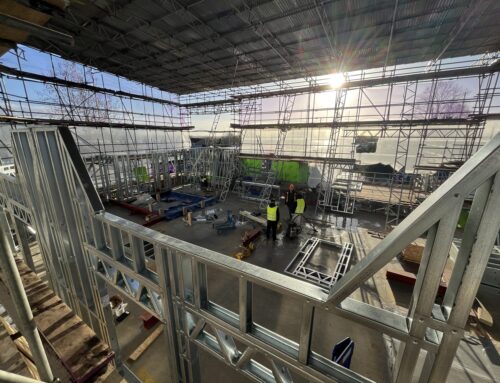
This is where industrialised construction steps in – not as a trend – but as a practical delivery solution. By shifting a large portion of construction away from the building site and into a controlled manufacturing environment, Frameclad reduces reliance on site trades and replaces it with repeatable, precision-engineered light steel systems manufactured offsite. The result? Faster programmes, more predictable delivery and far fewer workforce related headaches.
Rather than waiting on multiple wet trades, projects using Frameclad’s systems can move forward with smaller site crews, shorter build durations and far less exposure to weather or workforce disruption. For live school environments and tight summer holiday programmes, that kind of certainty isn’t just helpful – it’s a game-changer.
More certainty, less risk
Industrialised construction only works if it’s backed by the right expertise and that’s where Frameclad adds real value. Our factory-led production process improves quality control at every stage, helping to reduce defects, rework and delays often linked to onsite labour shortages. By designing, manufacturing and delivering light steel frame systems that are engineered for efficient installation, Frameclad supports a more streamlined construction sequence on-site. That gives contractors greater confidence in hitting key milestones.
Faster builds, safer spaces
With 24 education projects completed in the last 12 months, Frameclad has a proven track record of delivering education spaces that are faster to build, safer to use and sustainable by design.
Safety is at the heart of everything we do. UK education buildings demand high levels of fire protection. With over 50 fire tests completed, UKAS accredited certification and fire resistance of up to 120 minutes, our light steel systems provide reassurance for education estate managers, designers and contractors alike. Systems undergo independent rigorous testing to ensure compliance with current regulations and to protect staff, students and property.
And then there’s speed. With traditional construction facing workforce shortages and extended onsite programmes, Frameclad’s precision-engineered light steel frame systems move much of the work offsite. Prefabrication means smaller site crews, shorter build times and less disruption – a must for live schools or tight term time deadlines. Our loadbearing and non-loadbearing infill systems are designed to streamline installation, reduce rework and deliver cost-effective results, while allowing architects and contractors to be creative without compromise.
The road to net zero
Sustainability is equally critical. Frameclad’s steel has always been produced with recycled content, but we are taking it up another gear with our ECO-LSF systems. Made from 100% recycled steel using low-carbon Electric Arc Furnace technology, reduces CO2 emissions by up to 70%, supports circular construction practices, and delivers environmentally responsible solutions without compromising fire safety or structural integrity. For projects aiming to hit net zero targets, Frameclad’s approach shows that sustainability and performance can go hand in hand.
Put simply, if the construction sector is being asked to deliver more schools, more extensions and more refurbishments at speed, our light steel frame solutions offer a faster more resilient way to build than traditional methods alone.
To learn more about how light steel frame can help meet demand without compromising safety, speed and sustainability performance, download Building the Future of Education at: www.frameclad.com/downloads