Since the launch of the Government’s new housing targets, local authorities and councils are facing massive challenges, with many saying the targets simply cannot be achieved. Nik Teagle, Joint Managing Director of Frameclad takes a pragmatic view on what can be done to help.
People need homes and although a priority for the Government, what baffles me is that construction does not appear in the first draft of the industrial strategy which is due to be finalised in spring 2025. The strategy currently concentrates on eight favoured industrial sectors, including clean energy, creative industries, defence, ‘advanced’ manufacturing and digital technologies. Construction whether of the advanced sort or otherwise – is not on the list.
I think we all agree that we need to get some momentum back into the residential market. But rather than set a target we need an actual delivery plan. I see this as a massive opportunity for light steel frame specialists and we are gearing up to meet this demand.
Testing and accreditation
2025 has got off to a cracking start, as once again for the seventh consecutive year, we have achieved BOPAS Accreditation. Thanks to our talented team, we passed the rigorous assessment without any non-compliances.
You might ask, why is this so important? Our light steel systems are being widely specified in the residential sector. BOPAS provides assurances to lenders, developers, contractors, housing associations and homeowners, that construction systems designed, manufactured and installed by accredited MMC providers, will conform to industry best practice, in terms of durability and system integrity. Most importantly, BOPAS gives assurances that our offsite manufactured light steel systems will stand the test of time and will exceed 60-years or two mortgage terms. This is incredibly important to us.
Building safety is now rightly at the top of the agenda but the regulation of construction products has not received the same level of attention. The UK government extended the recognition of CE Marking for construction products indefinitely in September 2024. This was after the previous administration set a deadline to replace CE Marking by June 2025. This is due to the fact that there is insufficient testing and certification capacity in the UK to provide the volume of conformity assessment that would be required were CE recognition to end.
Housing developers will be appointed to deliver social housing schemes at scale whilst meeting Building Safety Standards and sustainability objectives, but with so many untested products on the market, it is going to make a difficult task even more challenging. At Frameclad we made a conscious decision to invest vast sums in fire testing, certification and accreditation. We have a growing bank of test data and when it comes to bespoke light steel solutions, we develop testing programmes with our construction partners.
So why choose light steel frame?
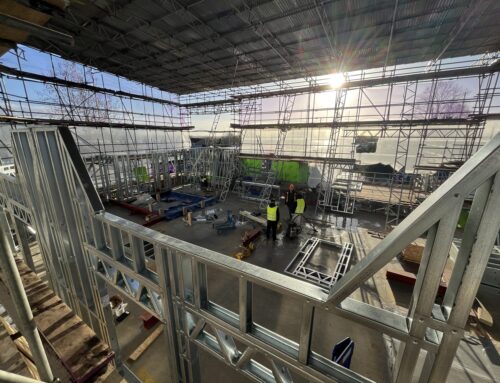
With its powerful combination of safety, strength, speed and affordability, light steel frame is a cost-effective option for residential projects. As a key offsite construction method, it is a fast and efficient way to build. Meeting Building Regulations and Building Safety Standards, our light steel systems have the all-important BOPAS accreditation, plus according to the Steel Construction Institute (SCI), have a design life more than 250 years in a warm frame environment.
Keeping tenants and homeowners safe, since the Building Safety Act came into force, light steel frame is becoming the preferred choice for housing projects. Robust and non-combustible, light steel frame creates highly airtight buildings reducing energy costs for the lifetime of the homes.
Economic gains of light steel frame
With no shrinkage or settlement, light steel systems deliver residential buildings with longer lifespans without the need for remedial works and repairs. The stability of steel also leads to major reductions in long term maintenance cost – a major consideration for cash strapped local authorities and social landlords. Construction finance can be expensive, and the building programme duration is critical to costs. It is the speed of construction delivering steel framed panels or modules that can dramatically decrease the programme schedule. Reducing the borrowing period can dramatically cut the interest paid and total project costs.
Avoiding overheating issues
In addition to being strong and economical, light steel frames also provide excellent thermal insulation properties. This means that heat transfer from outside sources is kept to a minimum while internal temperatures remain constant to avoid overheating during the summer months. The frames have exceptional acoustic performance which makes them suitable for use in areas where noise pollution needs to be reduced or even eliminated.
As we know, the pressure is constantly high to provide increasingly large volumes of quality homes. By using light steel frame systems and offsite manufacture, this pressure can be substantially eased and gives local authorities and housing providers the confidence that homes can be delivered cost effectively and with energy efficiency at their core.